Understanding lifecycle cost, corrosion risk, pressure performance and system flexibility.
Material comparisons in compressed air systems often begin with upfront cost. That’s understandable – installation budgets are visible and immediate.
However, long-term performance issues rarely stem from the initial invoice.
They tend to emerge years later, when production expands, layouts change, additional drops are required, or maintenance begins to interrupt operations.
The real cost of a compressed air system is revealed over time. Material selection influences energy efficiency, reliability, maintenance exposure, compliance considerations, and how easily a system adapts as operations evolve.
This guide looks beyond installation price to the factors that shape performance across the life of a compressed air network.
Read our guide: Design Considerations for Compressed Air Piping Systems.
Quick Comparison: Compressed Air Piping Materials
No single piping material suits every compressed air installation. Each has strengths depending on the environment, installation constraints and long-term operating requirements.
The right choice depends on how the facility operates today and how the system may need to evolve.
Aluminium
Best suited to adaptable systems
• Lightweight installation
• Stable internal bore
• Easy system expansion
Stainless Steel
Best for corrosive environments
• Excellent corrosion resistance
• Suitable for washdown areas
• Performs well in coastal environments
Galvanised Steel
Often used in static installations
• Lower upfront material cost
• Physically robust
• Harder to modify later
Plastic/Poly Systems
Common in light-duty installations
• Lightweight
• Corrosion resistant
• Lower pressure & fire limits
Copper
Typically used in smaller systems
• Smooth internal surface
• Corrosion resistant
• Less common in large industrial networks
See the full material comparison below.
Why Upfront Cost Is Only Part of the Equation
Compressed air systems operate continuously. Small inefficiencies don’t stay small, they accumulate.
- A modest pressure drop increases compressor load.
- A developing leak increases energy waste.
- A rigid layout complicates expansion.
When pipework becomes difficult to modify or maintain, operational costs start to gradually rise.
Material selection should therefore be assessed through a lifecycle lens, not solely on supply cost per metre.
What Drives Long-Term Cost in Compressed Air Systems?
Several factors typically have greater impact over time than installation pricing alone.
- Pressure Drop & Energy Consumption
- Corrosion & Internal Stability
- Leak Development Over Time
- Installation Disruption
- Ease of Modification & Expansion
- Compliance, Standards & Risk Considerations
Material selection influences system performance long after installation.
Energy use, maintenance exposure and future flexibility are largely determined by decisions made at specification stage.
Pressure Drop & Energy Consumption
Compressed air is one of the most energy-intensive utilities in industrial facilities.
Internal surface condition plays a critical role. Materials that maintain a smooth internal bore over time help limit friction losses and support consistent pressure delivery.
In contrast, materials prone to internal corrosion, scaling or roughness can increase resistance — requiring compressors to work harder to maintain pressure setpoints.
Over years of operation, even small increases in pressure drop can materially affect energy consumption.
Read our guide: Pressure Drop Troubleshooting in Compressed Air Systems.
Corrosion & Internal Stability
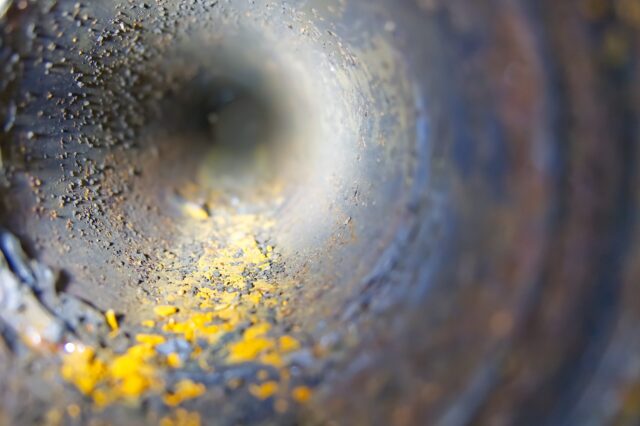
Some traditional materials, particularly untreated steel systems, may be susceptible to internal corrosion over time.
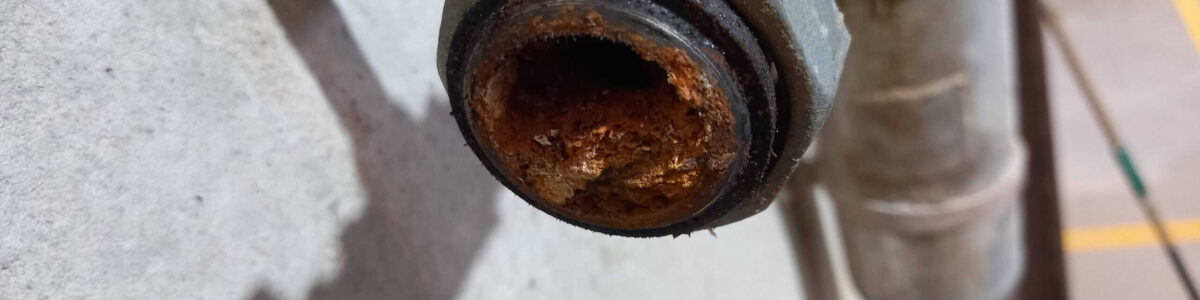
Potential consequences include:
-
- Reduced internal diameter
- Increased pressure drop
- Particulate contamination
-
- Increased filter loading
- Maintenance intervention
In applications where air quality is important – such as food processing, high-care production areas, or sensitive manufacturing – internal material stability becomes a key consideration.
Leak Development Over Time
Leaks rarely occur immediately after installation. They more commonly develop as threaded joints loosen, seals age, or systems are modified repeatedly.
Even minor leaks increase compressor cycling and energy waste.
Connection method, joint design and system layout all influence how well a network maintains integrity over time.
Installation Disruption
Installation method affects more than labour cost.
Systems requiring welding, threading or hot works can:
- Extend installation duration
- Increase shutdown requirements
- Introduce additional safety controls
- Depend on specialist trades
Mechanical connection systems can reduce installation time and minimise disruption – particularly in live operational facilities.
Ease of Modification & Expansion
Few facilities remain static.
Production changes. Equipment moves. Capacity increases.
If pipework is difficult to modify, each adjustment can require significant downtime or rework.
Modular systems allow additional drops, extensions or layout adjustments with less disruption to existing infrastructure. In growing facilities, that flexibility becomes commercially relevant.
Compliance, Standards & Risk Considerations
Compressed air networks may need to align with applicable Australian Standards and site-specific compliance requirements.
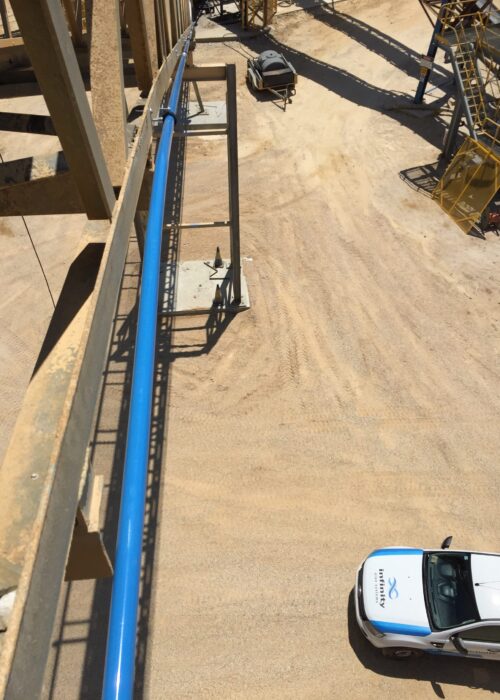
Infinity aluminium piping systems are manufactured to meet relevant pressure piping requirements, including compliance with AS4041 Pressure Piping technical criteria.
Additional considerations in material selection may include:
- Pipe identification requirements (AS1345)
- Fire performance in segregated areas
- Environmental exposure (UV, external conditions)
- Pressure ratings and temperature ranges
In facilities requiring fire-rated separation between zones, full-metal piping systems may provide greater assurance than combustible alternatives.
Material choice should support compliance confidence – not create future exposure.
Design Characteristics That Influence Performance
Material selection is important, but system design also plays a major role in long-term performance.
Internal Surface Condition
Maintaining a consistent internal bore helps limit friction losses and supports stable pressure delivery across the network.
Condensate Management
Moisture is unavoidable in compressed air systems. Effective drainage and condensate management help reduce corrosion risk and protect downstream equipment.
Multi-Gas Capability
Some facilities use the same network to carry compressed air, vacuum, nitrogen or CO₂. Selecting materials compatible with these gases can simplify infrastructure planning.
Check out Infinity’s patented Zero-condensate Reducing Tee.
Comparing Compressed Air Piping Materials: Strengths & Trade-Offs
No single piping material can be categorically assigned “the best”. Each has strengths and limitations. The appropriate choice depends on how the facility operates today and how it may evolve.
The table below summarises how common compressed air piping materials compare across several practical installation and performance factors.
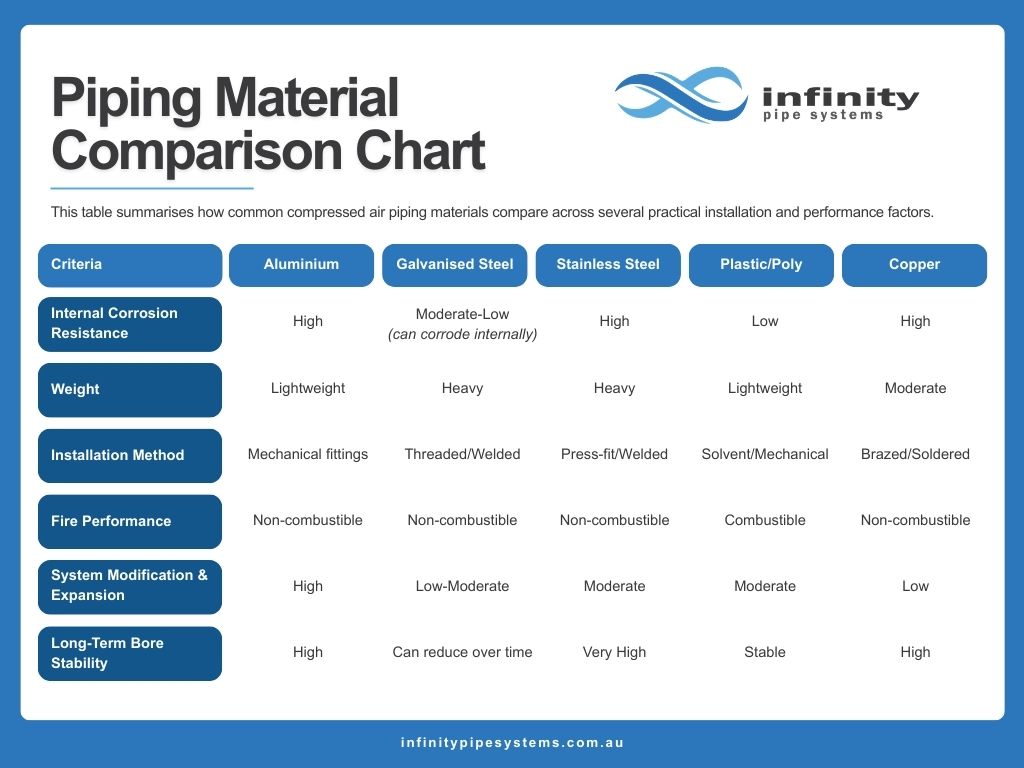
In practice, many systems combine materials – selecting each based on environment, compliance requirements and future expansion needs.
The sections below explore the advantages and limitations of each material in more detail.
Aluminium Compressed Air Piping
Aluminium modular systems are often selected in industrial environments where internal stability and future flexibility are priorities.
Strengths
Corrosion Resistance
Aluminium forms a natural oxide layer that protects the internal surface. In compressed air applications, this helps maintain bore condition over time and supports consistent pressure performance.
Stable Internal Surface
A smooth internal wall helps limit friction loss and maintain predictable pressure delivery across the network.
Modular Adaptability
Mechanical fittings allow extensions, additional drops or layout adjustments without welding or threading. In facilities where production changes are expected, this can reduce future disruption.
Installation Efficiency
Mechanical joint systems can reduce installation time, particularly in live environments where shutdown windows are constrained.
Non-Combustible Construction
Full-metal systems provide confidence where fire performance and compliance are considerations.
Multi-Gas Compatibility
When correctly specified, aluminium systems can support compressed air, vacuum and certain inert gases – simplifying infrastructure planning.
Considerations
Higher Initial Material Cost
Aluminium systems are typically more expensive per metre than galvanised steel or some plastic systems.
Installation Discipline Required
Mechanical systems rely on correct fitting preparation and torque control to maintain long-term integrity.
Impact Sensitivity
While durable in industrial settings, aluminium does not have the same mass-based impact resistance as heavy steel pipe.
Rated Operating Limits
As with all materials, aluminium systems must be selected within certified pressure and temperature ratings.
See how aluminium compressed air systems compare with plastic piping: aluminium vs plastic compressed air piping
Stainless Steel Piping
Stainless steel provides long-term resistance in environments where moisture, chemicals or washdown conditions are unavoidable. It is commonly specified in hygienic, high-care or corrosive environments where material stability is critical.
Strengths
Exceptional Corrosion Resistance
Stainless steel offers very high resistance to corrosion, particularly in wet or aggressive environments. This makes it well suited to washdown areas and facilities exposed to chemicals or moisture.
Hygienic Surface
The smooth, non-reactive surface supports applications where air quality and cleanliness are important, including food, beverage and pharmaceutical production.
High Temperature & Chemical Resistance
Stainless steel performs reliably in environments with higher temperatures or exposure to cleaning chemicals.
Non-Combustible
Like other metal piping systems, stainless steel provides confidence where fire performance is relevant.
Considerations
Higher Material Cost
Stainless steel systems generally carry higher material costs than aluminium or galvanised steel.
Heavier Installation
The material weight can increase installation handling and support requirements.
Modification Complexity
Changes or extensions often require cutting, welding or press-fit tooling depending on the system design.
Often Used in Targeted Zones
In many facilities stainless steel is installed selectively in washdown or hygienic areas, while other materials are used elsewhere in the network.
Galvanised Steel Piping
Galvanised steel has historically been used in compressed air networks across industrial facilities.
Strengths
Lower Upfront Material Cost
Often attractive in capital-constrained projects.
Mechanical Robustness
Strong and resistant to physical damage in high-traffic environments.
Temperature Tolerance
Suitable for elevated temperature applications when specified appropriately.
Considerations
Internal Corrosion Over Time
Galvanised coatings can degrade internally in moist air systems. This may reduce effective internal diameter and introduce particulates – rust – downstream.
Weight & Handling
Heavier pipe increases installation labour and support requirements.
Modification Complexity
Changes typically require cutting, threading or welding, increasing downtime exposure.
Long-Term Surface Roughness
Internal condition may change as systems age, potentially affecting pressure performance.
Plastic Piping (Polypropylene Systems)
Plastic systems are sometimes used in light industrial or workshop environments.
Strengths
Lightweight
Simple to handle and install.
Corrosion Resistant
Not susceptible to rust.
Suitable for Small, Static Systems
Can be appropriate in compact installations with minimal future expansion.
Considerations
Combustibility
Plastic systems are combustible and may not meet fire separation requirements in certain facilities.
Impact & UV Sensitivity
Some systems can become brittle over time or under UV exposure.
Pressure & Temperature Limitations
Typically lower operating thresholds than metal systems.
Specification Constraints
Certain insurers or standards frameworks may limit their use in higher-risk industrial applications.
Copper Piping
Copper is generally used in smaller systems or specialist environments.
Strengths
Corrosion Resistant
Maintains stable internal surface condition.
Smooth Bore
Supports consistent airflow in smaller networks.
Considerations
Material Cost Volatility
Copper pricing can fluctuate.
Scale Limitations
Often less economical for large industrial networks.
Mechanical Strength
Less impact-resistant than steel systems.
The Practical View
Material selection should reflect:
- Expected system lifespan
- Likelihood of expansion
- Downtime tolerance
- Compliance exposure
- Energy sensitivity
- Capital versus lifecycle cost priorities
In small, static environments, lower upfront materials may be entirely appropriate.
In facilities expecting growth, modification or higher operational demands, materials that maintain internal stability and allow incremental expansion can reduce long-term disruption.
For many modern industrial sites, that balance between stability and adaptability is increasingly influencing specification decisions.
Infrastructure should support operations, not just the installation budget.
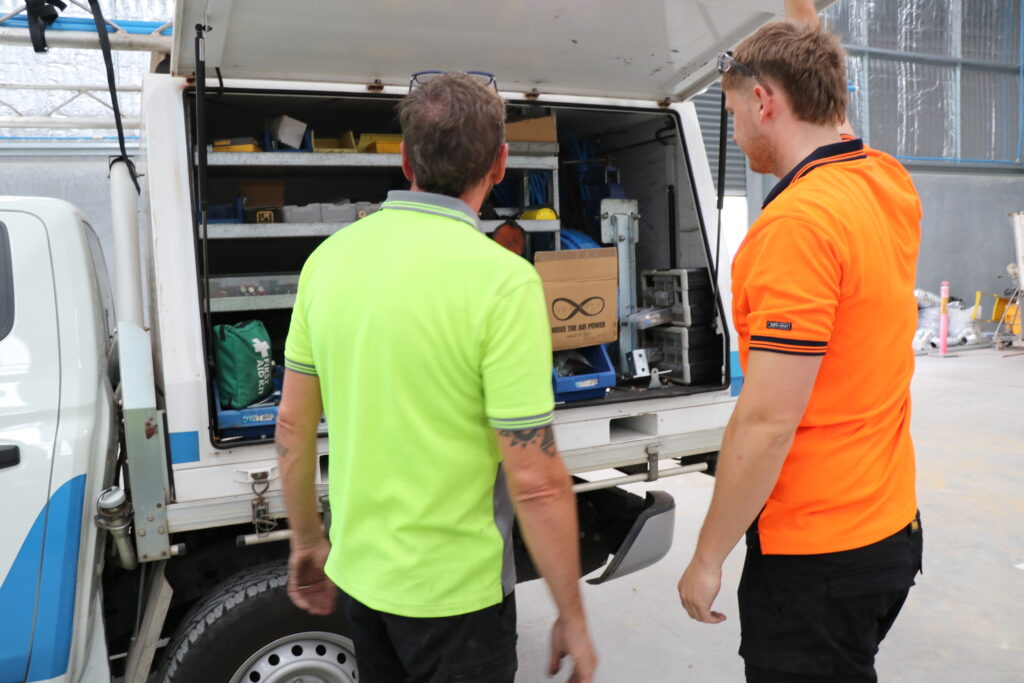
Selecting the right material is only one part of system performance. Layout and sizing also influence airflow stability. Check out our guide: Design Considerations for Compressed Air Piping Systems
When Each Compressed Air Piping Material Makes Sense
Different materials suit different environments. The key is aligning pipework with how the facility operates and how it’s likely to change.
Aluminium
Often selected where:
- Facilities expect future expansion or layout changes
- Installation speed is important
- Systems require stable internal airflow
- Energy efficiency is a priority
- Facilities want to minimise future modification disruption
Aluminium systems are commonly used in manufacturing plants, production facilities and workshops where networks evolve over time.
Stainless Steel
Typically specified where:
- Corrosion resistance is critical
- Washdown environments are present
- Hygienic processing is required
- Applications involve food, beverage, pharmaceutical or chemical production
Stainless steel systems are often used in targeted areas of facilities where environmental conditions demand higher material resistance.
Galvanised Steel
Often used where:
- Systems are small or unlikely to change
- Lower upfront cost is the main priority
- Pipework is installed in low-moisture environments
- Mechanical durability is important
However, long-term performance can depend heavily on moisture management and system maintenance.
Plastic/Poly Systems
Generally suited to:
- Light industrial or workshop environments
- Smaller compressed air systems
- Installations where weight and simplicity are priorities
However, fire performance, pressure limits and specification requirements should be carefully considered in industrial facilities.
Copper
Most commonly used in:
- Small compressed air systems
- Workshop environments
- Specialised applications
Copper can provide stable internal airflow but is less common in larger industrial networks due to cost and installation considerations.
In Summary
Compressed air infrastructure should enable production, not complicate it.
Each piping material brings advantages and trade-offs. The right choice depends on how a facility operates, how often it changes, and how much value is placed on energy stability, compliance confidence and ease of modification.
Upfront pricing is only one part of the equation. Over time, factors such as internal surface condition, leak potential, installation method and adaptability can have greater influence on operational cost and disruption.
For static, low-complexity environments, simpler materials may be sufficient. In facilities expecting growth, reconfiguration or higher performance demands, long-term stability and modular flexibility often become more significant.
Compressed air systems are long-life infrastructure. Selecting materials that align with operational intent – not just capex, or installation budget – helps reduce lifecycle exposure and support consistent performance over time.
Because in compressed air networks, the true cost rarely shows up at commissioning, but it sure becomes clear in the years that follow.
What is the most suitable material for compressed air piping?
Material selection depends on the operating environment, installation constraints and how the system is expected to evolve. Key considerations include corrosion exposure, hygiene requirements, fire performance, modification flexibility and long-term pressure efficiency.
In many facilities the most practical approach is selecting materials to suit different areas of the system rather than applying a single material everywhere.
Where is aluminium piping typically used in compressed air systems?
Aluminium piping is commonly used for main compressed air distribution networks in manufacturing plants, workshops and production facilities.
Its lightweight construction and modular connection systems make it well suited to environments where layouts may change, additional drops may be required, or installation speed is important.
Why is corrosion important in compressed air pipework?
Internal corrosion can reduce pipe diameter, increase pressure drop and introduce particulate contamination into the compressed air system. This can increase energy consumption and maintenance requirements over time.
Maintaining a stable internal pipe surface helps support consistent airflow and long-term system reliability.
Can different piping materials be used in the same system?
Yes. Many modern compressed air networks use a combination of materials selected for different operating conditions.
For example, aluminium may be used for the main distribution network, while stainless steel is installed in washdown zones, hygienic processing areas or marine and coastal environments where corrosion resistance is critical.
When is stainless steel piping preferred?
Stainless steel is typically specified in environments where corrosion resistance and hygiene are priorities. This includes food and beverage production, pharmaceutical processing, washdown areas and facilities located in marine or coastal environments.
In many installations stainless steel is used in targeted sections of the system rather than across the entire network.
Does pipe material affect pressure drop?
Yes. Internal pipe condition can influence pressure loss across a compressed air network.
Materials that maintain a smooth internal surface over time help limit friction losses and support consistent pressure delivery. Systems where internal corrosion, scaling or roughness develop may experience increased pressure drop, requiring compressors to work harder to maintain operating pressure.
Proper pipe sizing and system layout remain equally important in controlling pressure drop.
How long should compressed air piping last?
Compressed air piping is typically considered long-life infrastructure and is often expected to remain in service for decades.
Actual service life depends on factors such as material selection, environmental exposure, condensate management and how frequently the system is modified.
Choosing materials that maintain internal stability and allow future expansion can help extend the usable life of the network and reduce the need for major rework over time.